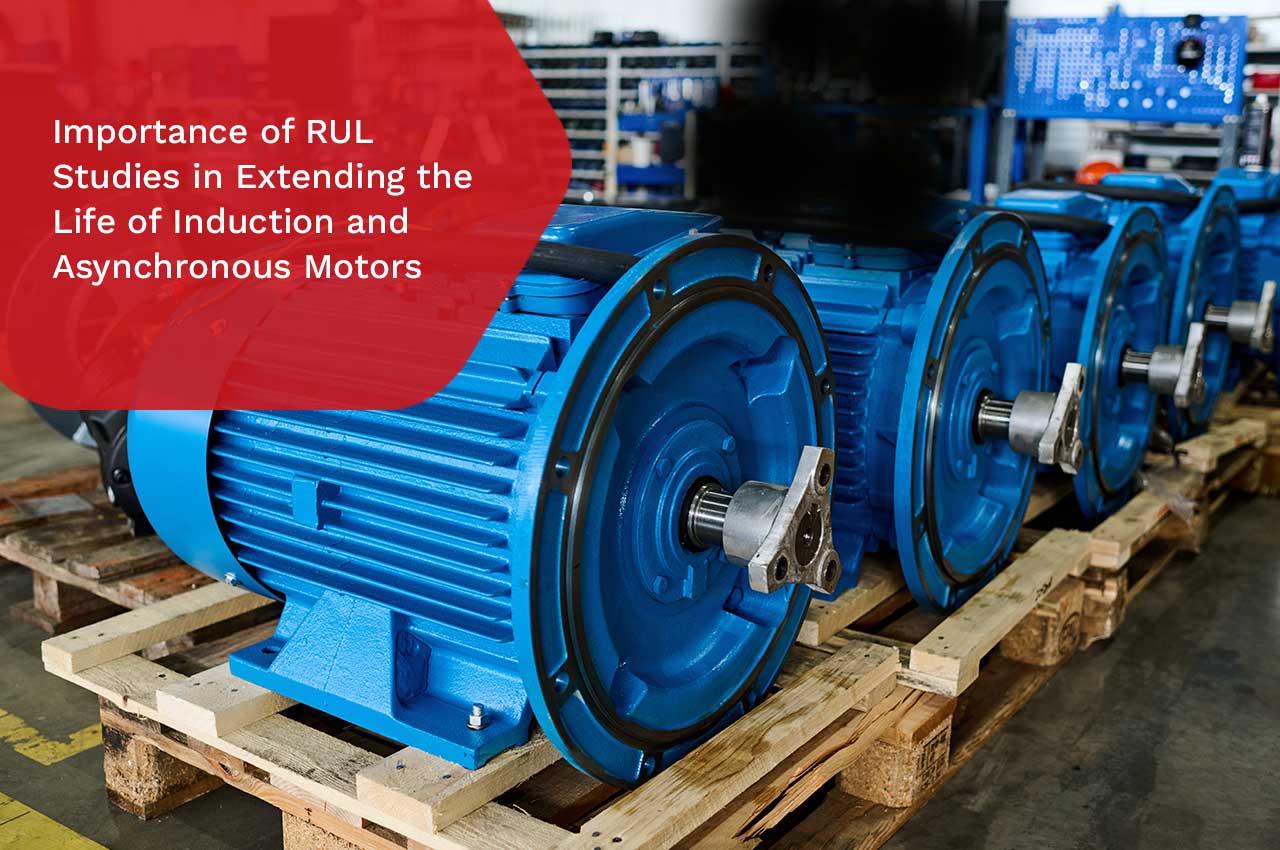
Importance of RUL Studies in Extending the Life of Induction and Asynchronous Motors
Rotational electric machines play a vital role in industrial facilities in order for them to be able to run continuously. The two most common types of machines used in industrial applications are the Induction motor and the asynchronous motor. Both types of motors are also used to operate various types of process equipment, including pumps, compressors, blowers, conveyors and many other heavy items.
To mitigate unexpected failures as much as possible, the industry utilises RUL study analysis. RUL study refers to an estimation of how many years a motor can operate before it will reach its designated functional failure limit. The Remaining Useful Life of a motor is derived from current operating conditions, as well as current operational stresses, which predict how much useful service life remains in a motor based on the motor’s current working environment. A structured RUL Study will utilise a variety of data sources, such as inspection reports, diagnostic test results, historical data and analytical models to make a true-to-life estimate of a motor’s RUL.
Why is an RUL Study important for motors?
A RUL study analysis of your motor is critical for enhancing the dependability and utilisation of your motors and decreasing the overall maintenance cost related to your motors.
Prevent Unplanned Downtime
Unforeseen issues with an induction motor could result in the obstruction of production immediately. Unplanned downtime leads to the loss of production, inefficient use of labour and late or missed deliveries. The predictive nature of RUL predictions helps to provide advance notification of potential issues. The maintenance is, therefore, scheduled during previously planned shutdowns.
Decrease the Maintenance Cost
Using a time-based maintenance program may yield an overabundance of spare parts being replaced ahead of their useful life. In some instances, parts fail before they can be inspected and thus are not available for replacement. As you align your maintenance program to the actual conditions of the parts you are maintaining (RUL), unnecessary replacement is eliminated, and there are no emergency repair expenses.
Increasing Safety
Electrical motor failure is a major reason for electrical fires and mechanical accidents so early identification through RUL Study protects personnel and facilities from fire hazards and accidents due to mechanical failures.
- Increasing Motor Lifespan
With the detection of degradation early enough, appropriate corrective actions can be taken on a timely basis to greatly increase the life expectancy of Asynchronous motors and Induction motors.
Which Motor Components are Analysed in an RUL Study?
A comprehensive Remaining Useful Life (RUL) Study investigates all significant electrical and mechanical components affecting reliability and performance.
- Stator Windings & Insulation System
The winding insulation system is more sensitive to electrical stress and temperature than one would associate with a standard insulated electrical coil. Because the insulation material generates heat when experiencing overheating conditions, there is a direct acceleration of aging. The use of insulation resistance tests, dielectric strength measurements and polarisation index assists in determining the overall health condition of the insulation system.
- Rotor Assembly
The rotor is the most important component of an induction motor because it produces torque. Broken rotor bars, eccentricity and imbalance result in reduced efficiency and increased vibration levels. The use of diagnostic techniques like motor current signature analysis helps in the detection of these failures at an early stage.
- Bearings
Bearings are one of the most common failure-prone equipment components. Their wear is due to lubricant breakdown, contamination and misalignment. The vibration spectrum can be used to estimate the degradation and remaining useful life of bearings.
- Shaft and Alignment
Bearing and coupling damage is increased due to overloading caused by improper shaft alignment. An essential component of any RUL study is to perform alignment checks for proper alignment.
Final thoughts
Reliability is the measure of productivity in today’s industry. The induction motor or asynchronous motor are two major assets that are required to run without interruption and be efficient. Traditional methods of maintaining these machines cannot provide the reliability needed.
An RUL Study, when performed accurately, will provide helpful information. It will predict trends in deterioration and decrease unplanned failures. It will optimise the cost of maintenance and extend the useful life of critical pieces of equipment.
Understanding and using a Remaining Useful Life analysis is more than just an improvement to technology; it is a strategic investment in reliability, safety and long-term performance.
FAQs
Q. How does a RUL Study improve motor reliability?
A. It identifies component degradation early through diagnostics and monitoring, allowing corrective actions before failure, thereby improving uptime and operational consistency.
Q. How does improper alignment affect motor life?
A. Improper shaft alignment increases radial and axial loads, accelerates bearing wear, damages couplings, raises vibration levels, and reduces overall motor lifespan significantly.
Q. Can RUL estimation reduce maintenance costs?
A. Yes. RUL estimation prevents unnecessary part replacements and emergency repairs, helping organisations adopt condition-based maintenance and optimise maintenance budgets effectively.
Q. How do bearings influence Remaining Useful Life?
A. Bearings are highly wear-prone components. Excessive vibration, lubrication failure, and misalignment accelerate degradation, making bearing condition crucial in RUL prediction.
Q. Does power quality impact Asynchronous motor lifespan?
A. Yes. Voltage imbalance, harmonics, and electrical transients increase thermal and electrical stress, accelerating insulation aging and reducing motor operational life.


 Brands





 Applications


 Recent Posts